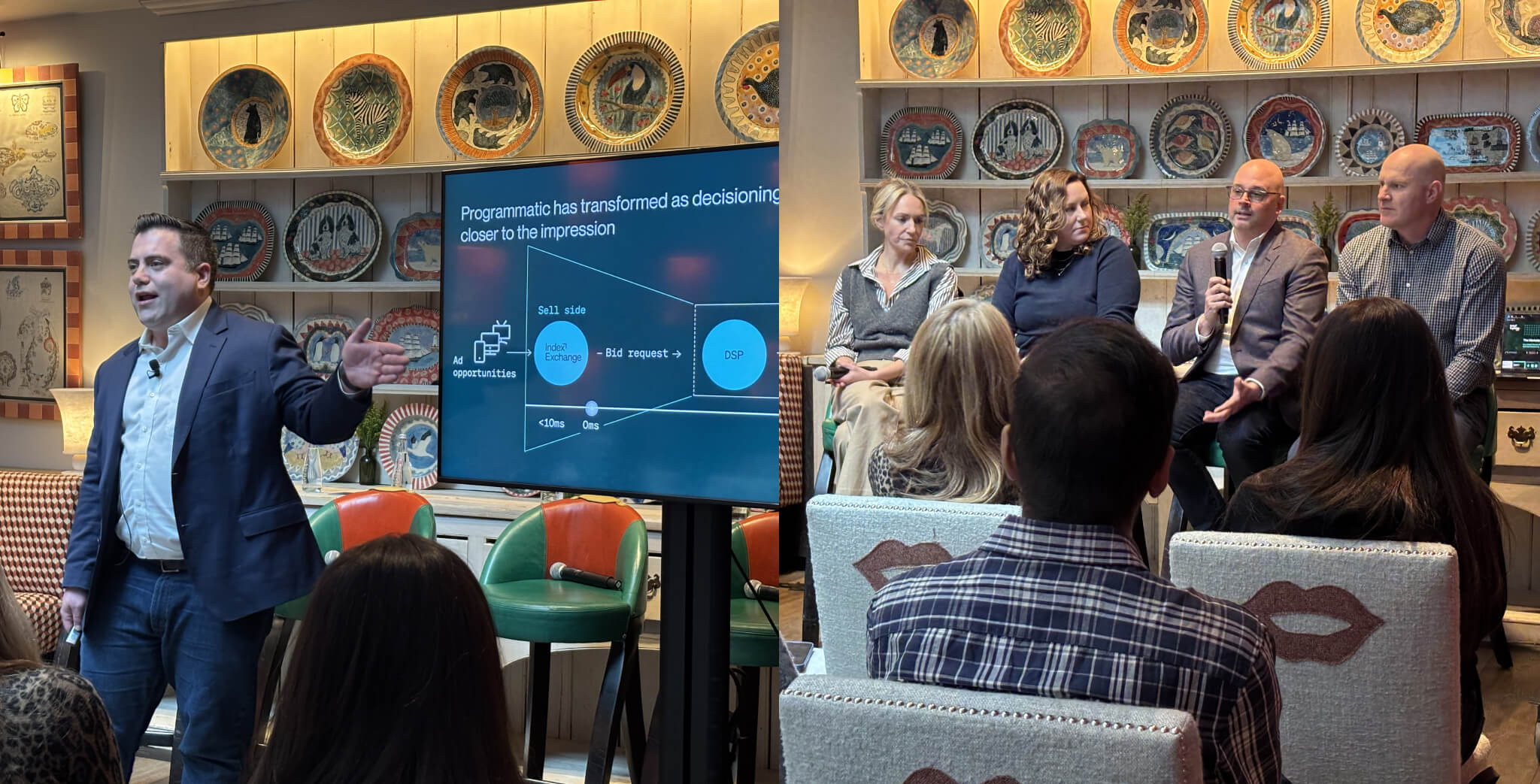
Sell-side decisioning is changing how value is created and captured in programmatic advertising. That shift, the focus of our inaugural Index Explains Live event in New York, creates a meaningful opportunity for media owners.
Sell-side decisioning provides greater control over how your inventory, audiences, and data are valued and transacted, while enabling a more active role in shaping outcomes.
We brought together leaders from across the ecosystem, including Amanda Grant of WPP Media, Amanda Martin of Mediavine, Patrick McCarthy of People Inc., and Dave Olesnevich of The Weather Company, to explore what sell-side decisioning means for media owners and how it’s playing out in practice.
Yesterday’s curation is not today’s sell-side decisioning
The resounding consensus across the panel is that the industry has moved far beyond the previous notion of curation. Even as recently as last year, curation was often viewed with skepticism—seen as a way to extract margin or as rigid, checkbox-based buying within DSPs.
That perception has changed.
Today, curation is a strategic capability: a way to package data, inventory, and insights into outcome-driven solutions. Buyers have become more sophisticated, and the ecosystem has matured.
Sell-side decisioning builds on this evolution, unlocking new ways to create and capture value.
A shift in where decisioning happens
Adding targeting, data activation, and packaging capabilities upstream allows you to act on richer, real-time context at the moment an impression is created. This creates a new pocket of innovation before the bid request is sent, where inventory, data, and decisioning can be aligned more effectively from the start.
Sell-side decisioning reshapes where value is created. Historically, the most strategic advantage has lived either close to the consumer (where data and context originate) or close to the dollar (where marketers’ budgets are allocated). It brings those points together by collapsing that gap into a single moment of decisioning.
This “smile curve” effect concentrates value at the impression itself, creating a more efficient and intelligent marketplace.
The opportunity to engage on your terms
The shift to sell-side decisioning expands the role of media owners, and it’s creating new opportunities to build more resilient monetisation strategies.
In fact, the top 100 media owners on our exchange have seen 53% higher eCPMs through Index Marketplaces (our platform built for sell-side decisioning) compared to the open auction.1 It’s a clear signal that decisioning on the sell side unlocks additional value.
Three key opportunities stand out:
1. Partner strategically to capture more demand
Sell-side decisioning gives you greater control over who you work with and how you bring inventory to market. You can build direct relationships with partners that align to your business goals—including data providers, commerce platforms, or agencies—to package inventory in mutually beneficial ways.
This changes how buyers engage. When supply is shaped earlier, it attracts not just more demand, but the right demand.
“Having a better opportunity to size up your audiences and identify larger ones before going to the DSP just allows us to have a better picture of what outcomes are going to look like.”
Amanda Grant, EVP, Global Head of Data and Tech Partnerships
WPP Media
2. Create new media products from your unique assets
Many media owners have long held valuable assets—first-party data, behavioural insights, contextual intelligence—that historically have been too difficult to readily deploy. Sell-side decisioning makes it easier to turn these assets into new media products, transacted through deal IDs.
This shift allows you to monetise signals more directly and bring new value to buyers.
“We have a ton of data, and it starts with about 25 billion personalised forecasts every day that we produce. That’s built up a lot of intelligence and insights around consumer behavior, intent, consumption, and emotion. Trying to bring that all the way downstream to a DSP—that’s going to get lost in translation sometimes. For us to be able to bring all that intelligence and package it up with our inventory…our advertising partners are getting better outcomes.”
Dave Olesnevich, Head of Product, Advertising, Data, and AI
The Weather Company
3. Expand reach through audience and content extension
Sell-side decisioning also enables you to scale beyond your owned inventory without losing control over quality or context. Whether by consolidating multiple properties into a single deal ID or forming strategic partnerships to create mutual scale, you can expand reach while maintaining the integrity of your data and signals.
“We’re able to take the insights that we learned across all of our properties and package it in a way that wasn’t possible before—and not only have it be available on our properties, but extend it to the open web as a whole.”
Patrick McCarthy, SVP, Programmatic Monetisation
People Inc.
It opens the door to new collaboration across the open internet and enables media products with greater scale and more competitive positioning than what walled gardens are able to provide.
This flexibility is what allows for the next major shift: combining differentiation with scale.
The power of combining niche and scale
One of the most compelling concepts sell-side decisioning creates is what WPP Media’s Amanda Grant coined as “niche at scale.”
Instead of choosing between highly differentiated audiences and broad reach, you can now package unique signals and extend them across a wider pool of inventory.
“Niche but scaled is the game changer for us.”
Amanda Grant, EVP, Global Head of Data and Tech Partnerships
WPP Media
Whether it’s weather-driven insights, behavioral signals, or contextual intelligence, activating specialised data in ways that are both precise and scalable helps compete more effectively with larger platforms.
It also expands opportunity across the ecosystem, creating new opportunities for smaller and more specialised DSPs to compete more effectively. In the past, buyers may have been constrained to working with larger platforms that were able to offer more features. Now, packaging inventory on the sell side means DSPs can access a wider variety of inventory, creating more options for buyers to work with a variety of niche platforms.
“One of the unique benefits of sell-side decisioning is that it really helps DSPs become more competitive. What we’ve seen is that by packaging up inventory and data before a DSP, it allows more DSPs to be valuable to the sell side.”
Amanda Martin, Chief Revenue Officer
Mediavine
Overall, this creates more optionality and competition, which makes for a more balanced ecosystem.
The value of sell-side decisioning for media owners
Media owners who succeed in this next phase of programmatic will be those who move beyond simply selling impressions and start designing outcomes. That means:
- Building products around your unique data and insights
- Partnering strategically to grow demand
- Taking an active role in how campaigns are structured
Sell-side decisioning makes all of this possible, while keeping you in control over how your inventory, audiences, and data are valued.
As the industry continues to evolve, the opportunity is yours to help define what comes next.
Learn more about the value of sell-side decisioning for media owners to see how you can earn more from every impression.
1Source: Index Exchange platform data, 24 February – 25 March 2026