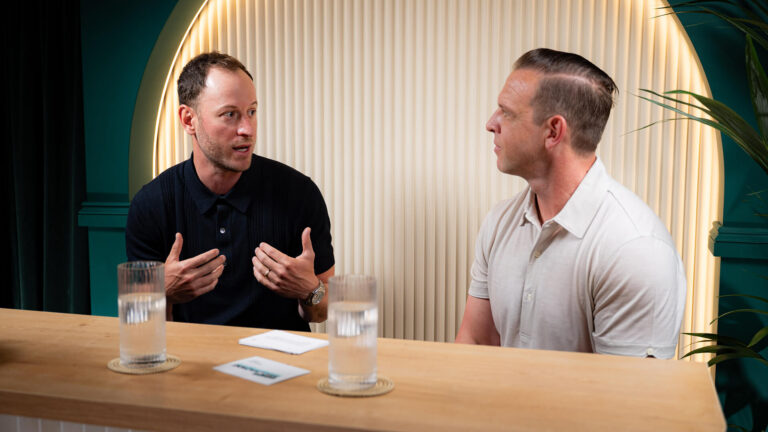
Want more? Check out the Innovators Unscripted Bonus Round with Mark Douglas.
MNTN’s Mark Douglas on precision, performance, and the future of streaming TV advertising
Welcome to Innovators Unscripted, a series where we share unfiltered insights from some of the most disruptive voices in today’s advertising ecosystem. Mark Douglas, CEO of MNTN, joins for a conversation on why precision, performance, and programmatic innovation are key to realizing streaming TV’s full potential.
The video transcript below has been lightly edited for clarity.
MNTN was instrumental in bringing performance marketers into streaming TV. What made that possible and why is streaming such an important channel for performance?
It’s possible because streaming has made television a digital advertising medium. That’s what enabled the possibility of doing it. Then, MNTN added precision targeting and attribution to measure, enabling precision delivery of the ads to the right consumer.
That’s so important because these are not big brands. These are midsize and emerging brands. They may be trying to find 1,000 new customers as opposed to someone like T-Mobile, where virtually everyone in America can be a customer.
“It’s got to be super precise. And that’s what we’ve enabled in our platform.”
How are you tapping into AI to improve streaming TV advertising today, and what do you think that will look like in the future?
AI is really important. The first thing is finding that consumer. For a brand who’s trying to find the next 1,000 or 5,000 customers—where you really have to pinpoint the audience—we can use generative AI to understand who their consumer is.
We can use machine learning models to then find that consumer among every household in America. So that’s the first part, is using AI technology for the targeting.
Then, 96% of our customers have never advertised on TV before, so they don’t have TV ads when we meet them. So we’ve started to roll out generative AI tools for creative.
So we have generative AI tools not just for the customer, but also for independent creators. We have a part of MNTN called QuickFrame. It’s a network of thousands of independent videographers who can build commercials for just a few thousand dollars, leveraging existing assets and increasingly, leveraging AI technology. We’re seeing the emergence now of what you can build using AI.
The streaming TV ecosystem continues to grow rapidly, but with that growth comes increasing complexity. What’s needed to make streaming more accessible and performant?
Well, I think you have to tame the complexity. That’s our job, that’s Index Exchange’s job, to make the complex easy for the brand.
Just a few years ago, advertising technology was about piecing it all together. And increasingly, that’s just not going to scale.
“It’s about having big platforms—a platform like yours, MNTN, and others—bring it all together and present it to the marketer and media buyer in a way that’s very simple and elegant, and, most importantly, very performant so you can measure the impact of that spend.”
You’re not going to get the performance without a lot of technology. That’s why right now, a third of the headcount at MNTN is engineering, and we’re going to end the year at half. One out of every two people that work at MNTN is on our engineering team.
Why is improving transparency critical for the future scale of the streaming TV market?
There’s an interesting aspect to that question, which is transparency. The industry has been moving so heavily into audience-based buys for television. That’s super important because ultimately what matters is that you’re delivering that ad, or that brand experience, to the right consumer.
But content on television often costs a million dollars or more an episode to create. So we think bringing content back into it is a really important element for the industry. It’s going to be a little bit back to the future.
I don’t think we’re going to fully go all audience. I think the networks are going to realize the value of this content is huge, and we need to keep that as part of the media buying. There are some interesting things coming in that area.
Collaboration is crucial to driving innovation in this industry. How does our partnership help you deliver stronger performance for marketers?
Collaboration is really important. Again, the company’s most focused on engineering and really providing the most precise ability to target and deliver full QPS—meaning that every impression is available to bid on. That’s really important.
Index Exchange excels at that, and that’s been one of the reasons we see the partnership as so important.
“There are so many partnerships in this industry that are more business-to-business. But with Index, it’s more engineering-to-engineering. That’s where we like to see it.”
If we were sitting down again one year from now, what’s one thing you hope the industry’s achieved?
This is an interesting question. The pendulum tends to swing very far, so it feels like even two years ago, programmatic was a huge part of streaming TV advertising. But it’s moved so far now that you can buy streaming media and you can’t really tell, was that a mobile ad or a TV ad?
I think it’s going to be, let’s bring TV back into TV advertising, programmatically.
“We’re going to be talking about the resurgence of TV in TV advertising. And I don’t mean linear. I mean in streaming and programmatic, and bringing a bit more content back into the mix.”
What’s one trend or buzzword you’re actually excited about?
What I’m excited about is that there’s going to be a convergence between social and streaming TV. I think social media creators are going to become a big part of television advertising.
Something that happened at the Super Bowl is interesting. One of the brands, Poppi, had a commercial filled with big social media influencers. I say that’s the ad that not just sold the product, it sold the company. I think they got bought two months later by Pepsi.
“This convergence of influencers, social media creators, and TV is happening beneath us right now.”
It’s underway. By next year, I wouldn’t be surprised if that was another big conversation.
We break down all the complexities of programmatic streaming TV in our Index Explains video series. Tune in to learn how to make the most of your streaming investments.