This post was last updated on July 28, 2026.
Today, we’re announcing a new layer of Index Exchange’s infrastructure, now available to partners. Index Cloud is our neutral compute environment, built inside our global data centers, where partners can choose to deploy their own models, data, and applications directly inside the exchange and run them within our real-time transactional environment.
Partners bring the intelligence. Index provides the environment. Partners control what runs inside.
Because Index Cloud is a cloud we own and operate ourselves rather than a public cloud, the signals available at the point of transaction can be richer, the latency is lower, and the overhead and costs that come from running outside the auction do not exist.
Why intelligence needs to move closer to the transaction
Programmatic has always placed its most powerful decisioning far from where impressions actually originate. A consumer loads a page, an ad opportunity fires, and a bid request travels across the internet, typically to public cloud infrastructure, where a decision is made and sent back.
Every hop in that journey adds latency, reduces signal fidelity, and incurs costs.
DSPs manage that cost by throttling inbound traffic, evaluating only a fraction of available impressions. Data providers send enrichment signals downstream and hope enough context survives the round trip. Agencies apply models after the fact, working with what is left rather than what was there at the start.
Index Cloud is built around a different premise: The richest signals exist at the point of transaction, and that is where intelligence should run.
How Index Cloud works
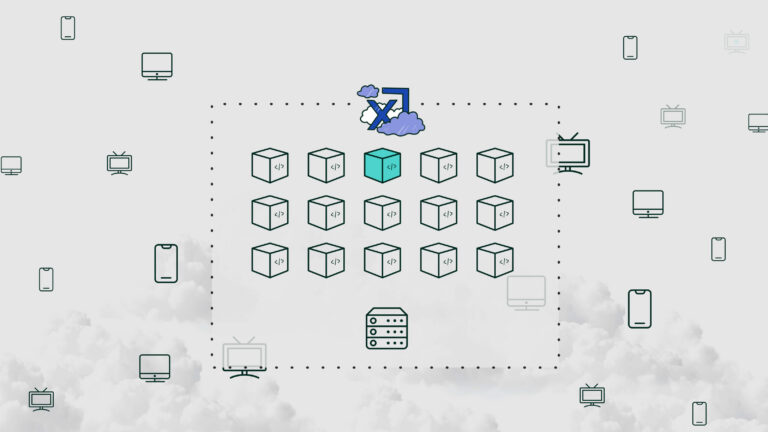
Partners deploy their logic inside Index Cloud using containers: lightweight, virtualized environments that package and run code in isolation directly inside the auction.
When an ad opportunity becomes available, a partner’s container receives impression-level signals, applies the partner’s own logic, and returns a decision, all before the bid request is constructed and sent to DSPs. The entire execution window is under five milliseconds.
Each container runs in strict isolation. Code and the container image is cryptographically signed by the partner and verified by Index, and access is tightly permissioned. DSPs receive decisions, not the intelligence behind them. What runs inside each container is controlled entirely by the partner.
Index Cloud is not built on GCP, AWS, or Azure. We operate our own cloud, purpose-built for programmatic at scale. Running adjacent to the exchange is not the same as running inside it, and the difference shows up in latency, signal quality, and cost.
Index was also one of the pioneering companies behind the Agentic Real-Time Framework, or ARTF, introduced by the IAB Tech Lab. We worked with the IAB Tech Lab and our partners to develop the standard, and our live container deployments directly informed its design. ARTF establishes a standardized way for containers to plug into exchange infrastructure in a consistent, secure, and interoperable way across the ecosystem, and Index Cloud is built in alignment with it.
The first containerized DSP running inside an exchange
Since launching containerization for custom models and data providers over the last few years, a new use case is now ready to join the fray: DSP bidders. Bedrock Platform is the first DSP to host an instance of its bidder directly inside Index Cloud. Rather than receiving bid requests into the public cloud and racing to respond, Bedrock’s bidder runs inside Index’s infrastructure, where it can participate in a materially broader share of the available supply.
The QPS constraints, latency races, and traffic shaping limitations that historically limited how much of the market any DSP can reach no longer impose the same ceiling when the bidder runs inside the exchange.
For Bedrock, this changes the economics of operating at scale. Infrastructure spend and market access have historically moved together: The more supply you want to see, the more compute you need to buy. Index Cloud decouples that relationship, letting Bedrock compete on the quality of its decisioning rather than the size of its infrastructure budget.
Bedrock retains full control of its bidding and decisioning logic throughout. Index provides the environment. Bedrock controls what runs inside.
“Scale shouldn’t be limited to the largest DSPs. By running our bidder closer to the impression, we can participate across a broader share of available opportunities without the QPS constraints we’d otherwise face, and compete on decisioning and performance rather than infrastructure.”
Shane Shevlin, Co-Founder and CEO
Bedrock Platform
What partners are building on Index Cloud
Index Cloud is live today, supporting a growing slate of partners and applications, with more joining as the platform continues to grow: Bedrock Platform, Chalice AI, inPowered AI, and Nano Interactive to name a few. Here’s what they’re building:
- AI-driven decisioning and optimization: Partners can deploy custom valuation and optimization models inside Index Cloud, applying their own bid logic in real time. Each impression is evaluated against partner-defined criteria at the point of transaction, where signals are most complete for those models to act on.
- Hosted DSP: DSPs can host an instance of their bidders directly inside the Index Cloud, running core decisioning engines inside the exchange rather than on public cloud infrastructure. This allows DSPs to participate across a broader share of available supply by removing their own QPS constraints and infrastructure overhead—without changing how the auction operates or affecting which DSPs are eligible to compete.
- Audience and signal enrichment: Partners can apply their own audiences, first-party data, and models directly against impression-level signals before bid requests are sent. Enrichment that previously required an outbound call and a round trip now happens locally, with no external dependency and no signal loss in transit.
- Deal activation: Partners can use their own scoring and decisioning logic to shape supply paths and activate deals at the point of transaction, applying criteria like anticipated performance.
- Contextual and content classification: Partners can run their own models against live content and placement signals for streaming TV, web, and app supply, bringing real-time content intelligence to bear on every impression rather than relying on classifications made before the auction begins.
- Impression valuation: Partners can evaluate each opportunity with their own pricing and response logic in real time, moving custom valuation models from the public cloud into the auction itself, where the signals that inform those models are most complete.
A more competitive open internet
The advantage that walled gardens have built over the past decade is rooted in infrastructure: data, compute, and decisioning all living in the same place, optimizing together. The open internet has competed on transparency, flexibility, and diversity of supply, but has accepted a structural performance gap as part of that trade-off.
Index Cloud changes the terms of that competition. When buy-side models, agency AI, data providers, and specialized technology companies can all operate inside the exchange at the point of transaction, the open internet gains the same fundamental capability that has made walled gardens efficient, without requiring any participant to give up autonomy, transparency, or control over their own intelligence.
Index provides the environment. Partners bring the value. The open internet keeps its defining characteristics. And every impression gets smarter from the start.
“We are at the outset of a structural shift in programmatic. When intelligence moves closer to the impression, the constraints that have historically limited scale begin to fall away. What emerges is a more efficient, more performant, and more powerful open internet.”
Andrew Casale, President and CEO
Index Exchange
Index Cloud is currently in closed beta with select partners.
If you’re interested in deploying your models, data, or application inside Index’s infrastructure, we want to hear from you.
Follow our progress and learn more.