Artificial intelligence is rapidly reshaping how people discover and consume information online. AI-powered search results, summaries, and overviews are changing long-standing traffic patterns—especially for queries that can be easily answered without a click.
As these experiences scale, publishers and marketers alike are asking what the AI impact on publishers means for reach, outcomes, and the future of the open internet.
How AI-driven discovery is reshaping internet traffic
To better understand AI’s impact on publishers, we analyzed activity across 1,200 publishers on our platform through 2025.
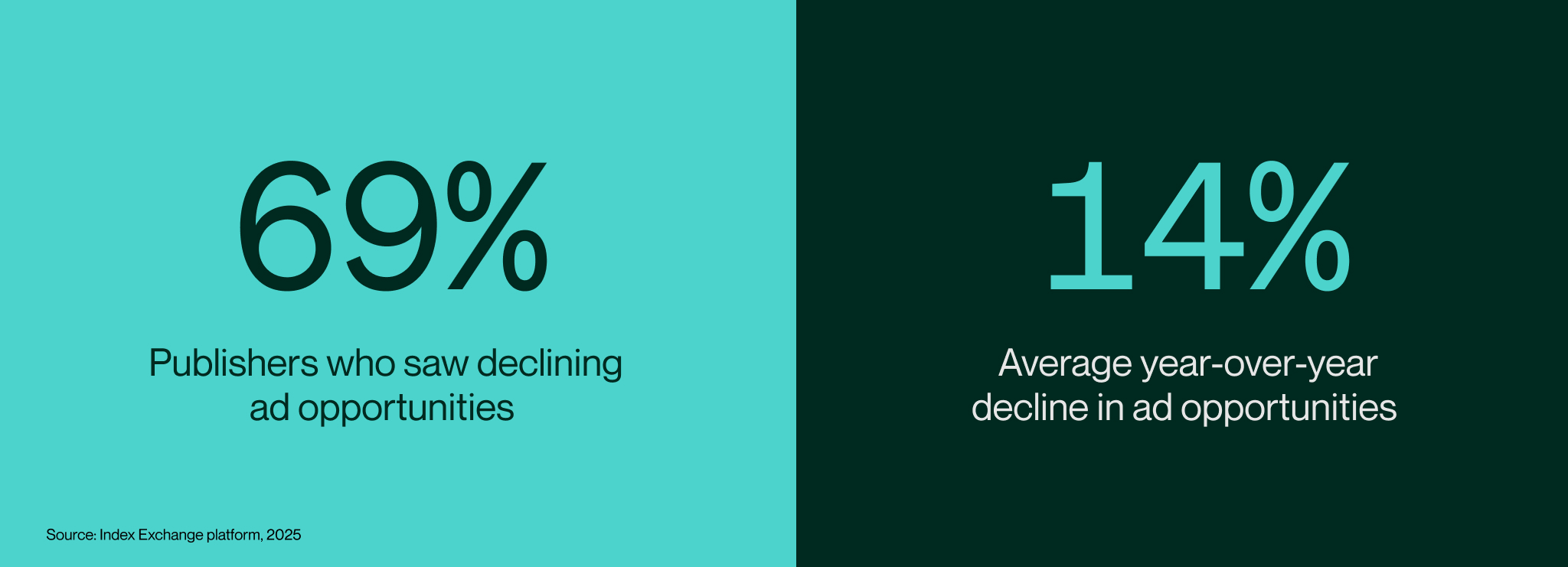
The data shows a clear pattern: 69% of publishers experienced year-over-year declines in ad opportunities, our closest proxy for monetizable traffic.
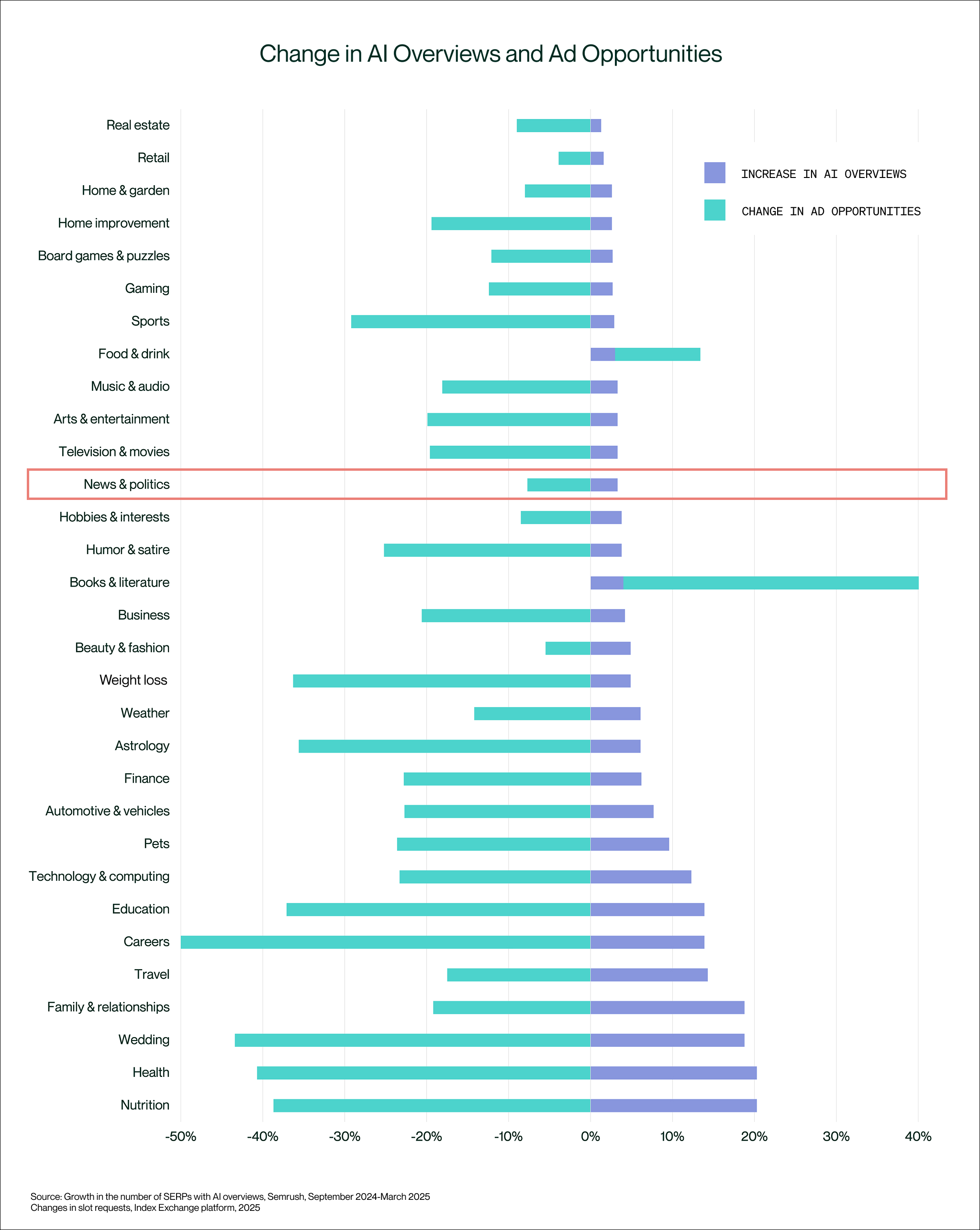
However, those declines are not uniform. When we compare AI exposure across content categories, verticals built around information-dense, “answerable” content—such as health, careers, and education—have seen some of the largest increases in AI overviews, alongside correspondingly steep declines in monetization signals.
News and politics, by contrast, has significantly lower exposure to AI overviews and a far more modest decline in ad opportunities. Ad requests only dropped 7%, whereas in some other content categories, like health and careers, they dropped 40-50%.
Why news publishers are more resilient to AI-driven search
This resilience matters not only for publishers, but also for marketers seeking trusted environments, engaged audiences, and durable performance as discovery continues to evolve.
“There have been growing concerns about how AI‑driven search may impact traffic to news publishers,” said Vanessa Otero, founder and CEO of Ad Fontes Media, a news ratings data and technology company that rates media sources in terms of political bias and reliability through a blend of human analysts and AI.
While overall traffic and monetization signals show pressure across the web, our data suggests that high-quality news is emerging as one of the most resilient—and increasingly valuable—areas of the open internet.
“These publishers provide essential value that AI cannot fully replicate—particularly trusted reporting and thoughtfully curated experiences that help audiences understand what matters most,” shared Vanessa.
Why quality news is becoming a stronger opportunity for marketers
For marketers, this shift creates a compelling opportunity. As AI reduces passive discovery, environments that audiences choose become more valuable. High-quality news delivers scale, frequency, and trust at a time when those attributes are increasingly scarce.
Research from Stagwell and HarrisX reinforces this dynamic: 73% of Americans follow the news closely, and one in four are “news junkies,” checking in an average of 5.6 times per day.
Marketers are recognizing news’ ability to drive meaningful engagement and performance—especially when paired with better tools, clearer standards, and more precise signals to ensure brand suitability.
That’s why Ad Fontes Media is joining Index Marketplaces, enabling media buyers to invest in high-quality news at scale with greater confidence and control.
Ad Fontes’ NewsAI data, which identifies high-quality news in real time down to the article level, is now available through our Data Vendor Ecosystem. Buyers can now apply this intelligence on the sell side at the point of impression, making it easier to drive better outcomes and direct investment toward trusted journalism.
“When it’s important enough that you want to be accurately and fully informed about some big international, national, or local event, a quality news site is still a much better experience than asking an AI chatbot, which may give a genericized or inaccurate answer. AI users already know this, which is why most news consumers still go direct to their trusted sites. News has always performed well for advertisers, and if the trend of news site resilience holds, this inventory will likely become the most valuable on the open web of the future.”
Vanessa Otero, Founder and CEO
Ad Fontes Media
Ad spend is growing for some news publishers—even as traffic softens
AI’s impact on publishers doesn’t mean the open internet is disappearing. It’s evolving. In our analysis of highly ranked news publishers across Ad Fontes and our exchange, we found that ad spend often diverged from ad opportunities.
In several cases, spend increased even as audience measures softened, reflecting the role of demand dynamics such as CPMs, fill rates, and buyer appetite. Even in a more zero-click world, quality signals and intelligent decisioning create opportunities for high-quality news to outperform.
Sell-side decisioning further amplifies these dynamics, giving publishers clearer pathways to demand that values quality while enabling buyers to activate against news inventory with greater precision, suitability, and performance alignment.
Most importantly, this approach supports a healthier open internet—one where trusted reporting is recognized, valued, and sustained. As AI continues to reshape discovery, growth depends on identifying, valuing, and investing in quality.
Learn more about how you can activate intelligence on the sell side and drive stronger outcomes with sell-side decisioning.